Coronavirus Australia live update: Daniel Andrews holds press conference after Victoria records 55 new cases and eight deaths
Victoria’s inquiry into hotel quarantine is on again today, and the day’s first witness is up. We’ll be bringing you all the developments today.
Earlier, documents tendered to the inquiry contained photos that allegedly showed guests in quarantine entering a convenience store outside their hotel, on the unfortunately named Rona Walk.
Victoria’s police commissioner, Tim Tully, was sent multiple emails by a former police officer, who raised concerns with how private security were managing hotel quarantine at the Pan Pacific Melbounre in South Wharf.
Redacted photos were included in the documents here in the annexures to Tully’s witness statement.
Naaman Zhou (@naamanzhou)
One of the photos from the Victorian hotel quarantine inquiry, showing an alleged breach of quarantine at the Pan Pacific hotel in South Wharf pic.twitter.com/zcUC6o0cBP
September 8, 2020
One email from 15 April, said: “Nigel and Tim. We have got the quarantined people out again this morning. One has tried to enter a convenience store on site.”
There is still some confusion, and questions over how you can wear a face mask for an entire visit, which includes eating and drinking, but here is what Victoria Health has so far on the “social bubble”:
VicGovDHHS (@VicGovDHHS)
From 11:59pm 13 September, if you live alone or are a single parent you can create a social bubble with one other person. Here’s what you need to know t.co/sH5yYCb9jt #COVID19Vic pic.twitter.com/pO1dtBkRiY
September 8, 2020
There are still local staff who work in the ABC bureau. Gaven Morris says he is worried about them as well:
We are concerned about them because they’re ABC staff. We want them to be safe and secure. We don’t have any information that they’re in any way under threat or anything like that. But we are talking to them constantly making sure they’re well supported and if anything we want a correspondent back there working with them as soon as is possible. China, understanding China, the relationship between our two countries is probably the biggest story of our time and having our people on the ground working with our local team is absolutely critical for the ABC.
Switching over the ABC now, and its news director, Gaven Morris is talking about the decision to very quickly bring back its China correspondent, Bill Birtles, after seven police turned up on his doorstep last week and said he was wanted for questioning in a national security case. He was told he was not allowed to leave the country. After diplomatic work, both he and the AFR’s Michael Smith, landed in Australia this morning.
Morris:
It’s been a long and trying few days. We’ve tried to work out what was going on, on the ground. Information was in short supply. What we really had to focus on was the very clear advice we were getting that it was best for Bill to leave the country. And so thanks to some extra consular support from the embassy in China, we have successfully brought Bill home and we’re very happy that he is here.
ABC journalist Bill Birtles waves as he arrives in Sydney after leaving China over arrest fears. Photograph: Taryn Southcombe/ABC News/AFP/Getty Images
Dr Nick Coatsworth will hold a national Covid update at 3.30pm.
Deputy chief medical officer Nick Coatsworth. Photograph: David Gray/Getty Images
The Australian Bureau of Statistics has put out its payroll data for August:
Payroll jobs across Australia fell by 0.4% over the month to 22 August, according to figures released by the Australian Bureau of Statistics (ABS) today.
Bjorn Jarvis, head of Labour Statistics at the ABS, said: “Over the month to 22 August, payroll jobs fell by 2% in Victoria while for the rest of Australia, payroll jobs rose 0.1%. While payroll jobs continued to fall in Victoria into the third week of August, it was at a slower rate than earlier in the month.”
Nationally, payroll jobs at 22 August were 4.2% below mid-March, when Australia recorded its 100th confirmed Covid-19 case. Payroll jobs in Victoria were 7.9% below the level reported in mid-March, compared with 2.9% for the rest of Australia.
Across Australia, payroll jobs in the accommodation and food services and the Arts and recreation services industries have suffered the largest losses during the Covid-19 period.
“While accommodation and food services and arts and recreation services have recovered close to half (40% and 49%) of payroll jobs lost since the low point in mid-April, they remain 21% and 14% lower than mid-March,” Jarvis said.
“These industries remain particularly hard hit in Victoria, where payroll jobs were 38% and 23% respectively below mid-March,” Jarvis said.
In mid-March, the four industries with the largest share of payroll jobs (41%) were healthcare and social assistance; retail trade; professional, scientific and technical services; and education and training. By 22 August, these industries were back to over 96% of the payroll jobs recorded in mid-March.
What about for businesses? They have been asking for more information.
Daniel Andrews:
The restriction announcements that we made are painful, they’re challenging, we acknowledge that, we understand that but we’re giving business an opportunity to provide direct input to the government about the support that they need and I think that’s a fair and reasonable thing to do. I think that’s a very important thing to do and as soon as we are ready to make announcements, they will be substantial, very substantial, but it is not for today but it will be soon.
Will NSW and Victoria see the same restrictions, if numbers come down?
Daniel Andrews:
The exact settings in place for New South Wales are a matter for the New South Wales government.
For instance, their border is closed.
We’ll get that border open, though, by driving our numbers down as low as we possibly can. There will be an ultimate point where things are in broad alignment.
Even coming out of the first wave, the way they treated poker machines, for instance, was different to the way we did it. The way they treated, you know, all sorts of different businesses. Whilst there’s similarities and a need for consistency in that ultimate sense, things are different in Sydney, different in regional New South Wales than they are here. Lots of things are similar, but there are some differences also.
What about what Scott Morrison has been saying – that he hopes Victoria’s roadmap is a “worse-case scenario”.
Daniel Andrews:
I’d say to the prime minister the worst-case scenario is being open for three or four weeks and then closed down again. That’s the worst-case scenario. Absolutely that’s the worst-case scenario and I’ll continue to work closely with the prime minister and his team. We’re grateful for the partnership that we have but in my judgment, if I can be so bold as to have a judgment on … would it be preferable to ignore the fact that we have much higher rates of community transmission than New South Wales? That doesn’t make any sense.
Should Victoria have used the same IT systems as NSW in its contact tracing?
Daniel Andrews:
I wouldn’t say that localised public health teams or regional public health teams or some officials going to Sydney to do a triple check – it’s not like they haven’t been talking.
They’re in constant contact. I wouldn’t accept that.
What I would say, though, is that, you know, the only way to avoid this sort of discussion is to blindly say the system is perfect and can’t get any better.
I’m not saying that. I’ve never, ever said that. We all have to – there’s no rulebook. There’s no playbook. There’s no guide here.
This is something none of us have done before and therefore you all learn from each other and there are plenty of insights that we’ve provided to New South Wales and Queensland and South Australia. It’s a proper model where we share not just resources but we share our experience and our insight so that everybody can do the very best that they can do. That’s what continuous improvement is all about.
When did the public health experts want to do this?
Daniel Andrews:
I think that people have wanted to see how regional teams worked. It’s something that’s been talked about for a while. It’s not necessarily being stood up next week. We’re announcing we’re planning to do it. We need to get the planning right and we’re confident we will.
Victorian premier Daniel Andrews addresses the media in Melbourne on Tuesday. Photograph: James Ross/AAP
When did Daniel Andrews realise this needed to be done:
It’s not a matter of realising it had to be done. This is a choice. Because the way regional public health teams have worked, and the fact that we’ve got numbers well down from the peak – so we’re into, you know, below 100 cases and we’re going to keep driving those down even further, the – as I said to Rachel, the kind of margin for error gets really, really small. The Colac example shows you, one person, two people, next thing it’s 25 people, but if it’s well managed, as that outbreak has been – and I want to congratulate all the team at Barwon health and all their partners and the people involved. They’ve been asked to do certain things, they’ve done them and that’s why, to the best of our knowledge as we stand here today, something that could easily have been 100 cases or more is not. It’s 25.
But what about NSW? Scott Morrison pointed to that system as the “gold star” standard.
Daniel Andrews:
On that point, there’s been constant communication, constant communication. But it’s important … not just to find things that are different, but to potentially just double-check that there are no differences.
So it’s for two purposes. So it is appropriate, particularly given what they’re dealing with now – very low case numbers.
They are where we want to get to and where we will get to under this strategy. It’s just appropriate to sit down and double check, triple check … no one could have literally counted the number of times there’s been phone calls, Zooms, data being shared.
It is absolutely connected. We speak with our colleagues. In fact, they’ve been doing some contact tracing for us, as part of … when things were at their absolute peak.
So there is a very strong connection, but it’s always worthwhile going first-hand, not over a 45-minute Zoom meeting, but in person, for as long as it takes, just to double and triple-check that there’s nothing that might be changed, or any insights, any experience – the other thing, too, is that it may not necessarily be that there’s much found that’s very different at all.
But because New South Wales are dealing with very small numbers of cases, that’s a different challenge to dealing with hundreds and thousands.
So they may have some insights into what we can expect to confront, not right now, but in three weeks, four weeks, five weeks’ time, so it just makes perfect sense.
Why wasn’t this done five months ago?
Daniel Andrews:
This comes into its own when numbers are low, and that’s the position we’re moving into now.
Q: The numbers were low between the first and second wave.
Andrews: Indeed. This is about continuous improvement. It’s not about saying that, you know, there isn’t an opportunity to do better. It’s looking for those – and often, often, it will be very, very small improvements, but the lower the numbers get, the lower your tolerance and threshold for error, the margin for error gets so slim that it’s then appropriate to devolve and that’s exactly what we’re doing. There’ll still be a big team at the centre. But having the most localised response – for instance, I’ll give you an example. I spoke with Commodore Hill this morning about the fact that a case, you know, well deep into regional Victoria where there’s not necessarily the laboratory capacity would mean you had to send that swab all the way to Melbourne. That can add two, three, four hours to that turnaround time. Once you get down to very, very low numbers, though, there are a number of health settings, a number of hospitals, who can run one or two tests. They can’t do a long run of tests, but they can do … they can do very small numbers and they can turn them around without all that travel time. So, for instance, some things become possible, some things come into their own, some things become absolutely essential when you get to very, very low numbers.
So I think that just as regional teams have played a critical role in the low numbers in regional Victoria now and keeping them low, suburban public health teams, coronavirus response teams, will be a very important part of that final push to get the numbers right down and to keep them there.
Q: That doesn’t explain why you didn’t do that three months ago before we …
Andrews: Well, this second wave is very different to the first wave. Very, very different.
Q: But you could have prevented the severity of the second wave.
Andrews:
I don’t accept that. I don’t accept that. At all. The key point here is with the amount of community transmission that we’ve got, with the amount of cases that we had, a more centralised model worked and that’s not a matter of my opinion. We’ve gone from 725 cases to 41 yesterday, 55 today. That’s a strategy that’s working. That’s a strategy that … it’s full of sacrifice.
It’s full of a lot of hard work from many, many people and, again, I’m deeply grateful to everyone who is playing their part, but I don’t accept that view.
This is now the time to do this, but there may be other things that I am not announcing today. There may be other things that become clear that there would be a benefit and we’d always reserve the right to make further announcements, refinements. That’s what a culture of continuous improvement is all about.
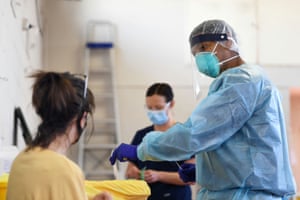
A healthcare worker prepares to conduct a Covid-19 test on a patient at a testing facility in Melbourne. Photograph: Reuters
Will those new contact-tracing teams be the same people reshuffled, or new people?
Daniel Andrews:
I think it will be additional people. It will be a mix. There might be leadership positions that are essentially from the centre that might go out to those teams. The final design is not yet settled but the model across regional Victoria is they’ve been added to the overall team.
When I say “added” there may be people who are not necessarily doing this work now but they’re on the payroll.
They’re working in a hospital setting, for instance. We’ll also look to local government, whether there are any supports that they can provide and then we’ll stand up those teams but I think the majority of the additional team members will be extra, or at least they will be tasked to these … This important work when that wasn’t what they were doing, if that makes sense.
Here is the new contact tracing measures, as explained by the Victorian government:
Bridget Rollason (@bridgerollo)
A new contact tracing management system is being set up and gov will start posting weekly contact tracing performance metrics online @abcmelbourne #springst t.co/0HKN4skMMZ
September 8, 2020
But everything will be based on the data, Daniel Andrews says:
Let’s not make announcements until we’ve got the data. We will ease in regional Victoria based on the data and science and take as big a step as we can provided it is safe. We didn’t put a timeline some of that. We said it would need to be when we got to that 14-day average because we knew, and we expect that we may get to that quite soon. We’re very, very close now but the last thing I would ever want is for people in regional Victoria who have given so much – numbers have got so low, we’ve got to make sure that when we do take those steps, that we’ve got a good picture of how [much] virus is out there and that it doesn’t get away from us very soon therefore.