Coronavirus live news: France infections accelerate; Spain to close nightclubs and ban public smoking
Coronavirus outbreaks are taking place across Europe and it is up to each country to decide on how to tackle them, Spain’s foreign minister said on Friday as Germany declared most of her country a risk region.
Germany followed the UK in imposing quarantine on people returning from Spain, further damaging hopes of a swift revival for tourism, which usually accounts for around 12% of the Spanish economy.
“New outbreaks are the norm, they are not the exception, in Spain or any other country in the European Union,” Arancha Gonzalez Laya told Reuters in an interview.
“Every country is taking measures to fight Covid… that they think are necessary to protect their citizens. We don’t question the measures other countries take.”
Some regions within Spain itself have limited movement with neighbouring areas to isolate flare-ups of the disease, “showing that this is not a question of diplomacy or politics, it is a question of epidemiology,” she said.
Spain recorded almost 3,000 new cases on Friday, about double the average in the first 12 days of August, bringing the cumulative total to 342,813 – the highest in Western Europe.
Earlier on Friday, Spain announced a series of measures limiting nightlife, including closing clubs and bars.
Asked whether the limits would impact tourism and the economy, Gonzalez Laya said: “The main question today is how do we make sure we limit infection and the expansion of Covid in the country.”
Croatia recorded 208 new coronavirus cases on Friday, the country’s chief epidemiologist Krunoslav Capak has said.
“The average age of those infected is 31 years as some two thirds were infected in the nightclubs and bars that remain open beyond midnight,” Capak told a news conference.
Croatia will require that bars and nightclubs to close after midnight for a period of 10 day from this weekend, similarly to Greece.
This follows Italy introducing mandatory testing for all those entering the country from Croatia, while Slovenia also floats the idea of requiring people visiting Slovenia from Croatia to present negative tests before entering the country. Austria has warned against visiting Croatia.
CROATIA-HEALTH-VIRUS-TOURISM
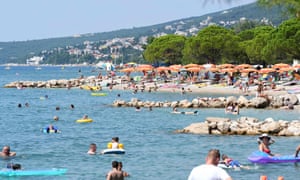
People, mostly foreign tourists, sunbath and swim on 13 August, 2020, in Crikvenica on the northern Adriatic coast. (Photo by DENIS LOVROVIC/AFP via Getty Images) Photograph: Denis Lovrović/AFP/Getty Images
A number of localised outbreaks in Europe, including in Italy and Germany, have been traced back to travellers returning from trips to party hot spots in Croatia in the past couple of weeks, notably from the island of Pag, Reuters reports.
Croatia has registered a total of 6,258 cases so far, with 163 deaths recorded.
To those of you just joining the blog, welcome. Here’s a quick summary of recent events to get you up to speed.
Think I’ve missed a story from your part of the world? You can reach me on Twitter @cleaskopeliti or by email: clea.skopeliti.casual@theguardian.com. Here’s the latest.
France has recorded another new post-lockdown record rise in cases, with 2,846 new infections. The UK has removed the country from its travel corridor, meaning all holidaymakers returning from France will have to self-isolate for two weeks, leading to British tourists scrambling to cross the Channel before the cut-off time on Saturday 4am BST.
In the UK, the North West, West Yorkshire, East Lancashire and Leicester face a third week under tightened coronavirus restrictions as the latest figures showed no decrease in the number of infections, the Department of Health has said.
Germany has declared almost all of Spain as a coronavirus risk region following surging infections – a further blow to the country’s tourism industry.
Greece is limiting public gatherings to 50 people amid a recent spike win cases. The measure will be in place until 24 August in areas with high infection numbers. The government has imposed a midnight curfew on bars and restaurants in Athens and other regions.
Serbia will require foreigners to present a negative coronavirus tests taken within 48 hours of arrival from Bulgaria, Croatia, North Macedonia and Romania from Saturday. The measure does not apply to Serbian nationals.
Spain is set to shut nightclubs and late-night bars and ban smoking in public nationally, the health minister announced today as part of measures to fight the country’s coronavirus outbreak. Smoking has been outlawed in all public spaces where people are unable to maintain a distance of 1.5m (virtually banning it in outdoor terraces of bars and restaurants).
The EU has reached a deal with British company AstraZeneca for at least 300m doses of its vaccine candidate. The deal includes an option to purchase a further 100m doses should the vaccine prove safe and effective.
Italy has ordered holidaymakers returning from Spain, Croatia, Malta and Greece to be tested for the coronavirus, as the number of new cases crossed the 500 mark for the first time in weeks.
US coronavirus hotspots had disproportionately high numbers of cases among communities of colour, according to an analysis by the Centers for Disease Control and Prevention (CDC).
The report contributes to a growing body of evidence that existing health and social inequalities experienced by communities of colour raised the risk of infection and death from Covid-19, the CDC said.
In 79 counties identified as hotspots that also had information on race, 96.2% had disparities in Covid-19 cases in one or more minority racial and ethnic groups between February and June, researchers concluded.
The largest disparities were reported among Hispanic people in hotspot counties (3.5 million people), followed by African Americans (2 million).
Asian populations were disproportionately affected by Covid-19 in a small number of hotspot counties, but the Asian racial category is broad and further analyses might provide additional insights, the researchers said.
The study did not assess disparities in Covid-19 related deaths because of the lack of available county-level mortality data, but the researchers said existing national analyses show there exists differences in Covid-19 deaths and similar patterns were likely to exist at the county level too.
Apart from long-standing discrimination and social inequities, other factors such as economic and housing policies, employment in meat packing, agriculture, service and health care sectors, and living in multifamily households could increase risk for transmission, the researchers said.
Canada will grant permanent residency to asylum seekers who cared for coronavirus patients in hospitals and care homes at height of the pandemic last spring, Marco Mendicino, the immigration minister has said.
Mendicino said the program is a way to thank those who “put themselves at the greatest risk” of contracting the coronavirus.
They will be able to apply for residency for themselves and their families if they had submitted their application by March 2020, even if their demand had already been rejected.
The decision would affect about 1,000 claimants across the country, the CBC reports.
France has declared Paris and the port city of Marseille high-risk zones for coronavirus as the government reported more than 2,500 new infections for the third day in a row.
However, the number of people hospitalised due to the disease continued to fall, having dipped below 5,000 for the first time since mid-March on Wednesday.
While the number of new infections is up in all age groups, it has risen particularly sharply among 25 to 35-year olds. The health care system appears to be holding up at least in part as this group is less likely to need hospital care.
The number of people in ICUs has fallen to 367, a new low since mid-March and a level almost 20 times lower than a 7,148 peak reached on 8 April.
Health ministry epidemiologist Daniel Levy-Bruhl said authorities are not “presently worried by the hospital situation but we are worried of how this situation could evolve if measures are not taken to stop the increase of cases we’re witnessing”.
The daily death toll increased by 18 to 30,406 on Friday, compared to 17 over the last two days.
France’s total number of cases stands at 212,211.
Oman will end its ban on night movement starting from 15 August at 5am local time (GMT +4), Oman’s supreme committee for dealing with Covid-19 has announced.
Oman has recorded 82,743 coronavirus cases, including 557 deaths and 77,427 recoveries.
عُمان تواجه كورونا (@OmanVSCovid19)
The Supreme Committee would like to draw everyone’s attention that the night movement ban will end at 5:00 am tomorrow morning, Saturday, August 15, 2020 and it appreciates the great response shown by the citizens and residents.#OmanVSCovid19 pic.twitter.com/fB31nJeu3h
August 14, 2020
From Reuters:
The French health ministry reported 2,846 new coronavirus infections over the past 24 hours on Friday, setting a new post-lockdown daily high for the third day in a row and taking the country’s cumulative total of cases to 212,211.
The seven-day moving average of new infections, which averages out weekly data reporting irregularities, increased to 2,041, doubling over the last two weeks, and going beyond the 2,000 threshold for the first time since 20 April.
Canada is preparing for a “reasonable worst case scenario” in which further surges of coronavirus cases would at times overwhelm the public health system, officials have said.
In this scenario, there would be a large peak later this year followed by a number of smaller peaks and valleys stretching to January 2022. Each of the peaks would exceed the health system’s capacity.
Hello, my name is Clea Skopeliti and I’ll be running the blog for the next few hours. You can get in touch with me on Twitter @cleaskopeliti or by email: clea.skopeliti.casual@theguardian.com. I won’t always have time to reply to everything but will read it all! Thanks in advance.
People in parts of northern England face a third week banned from meeting others in their homes or gardens as the latest evidence shows no decrease in the number of coronavirus cases, according to the Department of Health.
Households in areas of the North West, West Yorkshire, East Lancashire and Leicester cannot mix indoors – unless they are in a support bubble – and limits remain on numbers meeting outside.
While venues including casinos, bowling alleys and conference halls across England prepare to reopen on Saturday – following a two-week delay – such buildings will not be allowed to reopen in Greater Manchester, West Yorkshire, East Lancashire or Leicester.
The department said the latest evidence does not show a decrease in the number of cases per 100,000 people in those areas and health secretary Matt Hancock had, alongside local leaders, agreed that the rules should stay in place.
Germany is declaring nearly all of Spain, including the tourist island of Mallorca, a coronavirus risk region after a rise in cases there, government sources told Reuters on Friday.
The move deals a blow to hopes for a swift revival of mass tourism after months of lockdown to stop the spread of the virus all but wiped out this year’s high season for tourism in Europe.
Daily Bild had reported earlier that Mallorca had been added to the list of high-risk regions published by the Robert Koch Institute (RKI), Germany’s public health agency.
The sources told Reuters that all of Spain except for the Canary Islands would be included on RKI’s next list of risk regions.
Designations as risk regions are typically followed by the German foreign ministry warning against tourist travel to those areas and mean people returning from there face a coronavirus test or two weeks’ compulsory quarantine.
The Balearic islands, off Spain’s eastern coast, include holiday destinations such as Ibiza, among the most popular destinations for north European sunseekers.
Infections in Spain have increased in recent days following the end of Spain’s tough lockdown seven weeks ago.
Thousands of Albanians formed an enormous queue of cars at the Greek border today as they rushed to re-enter the country for work ahead of new virus rules, police said.
Around 4,000 cars were jammed in a 20km-long (12-mile) line at the Kakavia border crossing in southern Albania, in a build-up that has been growing since Greece announced tougher entry requirements at the start of the week to contain a surge in infections, AFP reports.
The changes came as thousands of Albanians who live and work in Greece, mainly in the agricultural sector, were preparing to return after summer holidays at home.
Under Athens’ new rules, daily arrivals from Albania will be capped at 750 after 16 August.
Hi. Caroline Davies here. I will be running the live blog for a while, taking over from my colleague Sarah Marsh. You can get in touch on caroline.davies@theguardian.com
In Greece, which has also seen a dramatic increase in coronavirus cases, authorities have announced further precautionary measures in an all-out bid to curb the spread of transmissions.
A midnight curfew on bars and restaurants was extended nationwide with businesses being ordered to adhere to the new rules in Athens and on popular islands including Paros, Antiparos, Kythera, Poros, Hydra and Aegina in the Argo-Saronic Gulf.
Public gatherings involving more than 50 people are also prohibited in areas that have registered a noticeable rise in infection rates.
As the tourist season goes into high gear – with ever more Greeks flocking to island homes and ancestral villages to mark the 15 August Dormition of the Virgin Mary, one of the biggest religious festivals in the Orthodox calendar – concerns over the spread of the virus among young people have never been higher.
A record rise in cases over the past week in Athens and Thessaloniki has been linked increasingly to younger Greeks returning from island holidays. Reports of overcrowding in bars and nightclubs have been rife. On Mykonos police have been forced to break up parties in private villas amid mounting fears of such events being “super-spreaders: of the virus.
Earlier today, as he met with health officials and senior epidemiologists to discuss developments, the prime minister, Kyriakos Mitsotakis, implored younger Greeks to have their wits about them.
“I especially want to appeal to our young people. Be careful, take care of yourselves, you are not invincible and those who are not invincible, even more so, are your parents and your grandfathers and grandmothers,” he said. “I won’t tire of repeating this … so we don’t find ourselves in the unpleasant position of having to take more drastic measures than we would want to.”
A total of 6,381 cases of coronavirus have been registered in Greece, which initially won global praise for its handling of the pandemic. Health officials have reported 221 Covid-linked deaths in the Mediterranean country to date. Infection rates exceeded the 5,000 tally a week ago.
Greece put in place a temporary 50-person limit on public gatherings on Friday, saying restaurants and bars in Athens and other areas must close by midnight.
The measure hopes to help the country contain a recent surge in Covid-19 infections. The deputy civil protection minister said the limit on public gatherings would last until 24 August and be imposed in parts of the country where infection numbers have risen.
“No measures can substitute for personal responsibility, particularly that of young people to protect their parents and grandparents,” the deputy civil protection minister, Nikos Hardalias, said.
Greece reported 262 new infections on Wednesday, its highest daily tally since the start of the outbreak in the country. Another 204 cases were reported on Thursday.
Germany’s public health agency declared the Spanish tourist island of Mallorca a coronavirus risk region after a rise in cases there, Bild newspaper reported on Friday.
Designations as risk regions by the Robert Koch Institute are typically followed by the German foreign ministry warning against tourist travel to those areas.