Coronavirus live news: global cases approach 22 million; WHO says Covid spread by ‘unaware’ younger people
Brazil reported 47,784 new cases of coronavirus and 1,352 deaths in the past 24 hours, the health ministry said on Tuesday.
Brazil has now registered 3,407,354 cases of the virus since the pandemic began, while the official death toll from Covid-19 has risen to 109,888, according to ministry data, marking the world’s worst coronavirus outbreak after the United States.
As Australia wakes up, here is a summary of the main developments from the last few hours:
Global coronavirus cases are approaching 22 million and the global death toll has risen to almost 776,000. According to the tally by John Hopkins University, thebiggest drivers of the case counts is the United States and Brazil. The US has recorded over 5.45 million cases and more than 170,000 lives have been lost.
The Netherlands could go “back to square one” if the country doesn’t control new infections, the Dutch PM Mark Rutte warned. Without imposing mandatory restrictions, Rutte gave people urgent advice not to hold parties at home and to limit events like birthday celebrations and other private house gatherings to a maximum of six people.
Ireland’s nationwide coronavirus restrictions are being “significantly tightened” until at least 13 September as cases surged at the fourth highest rate in Europe. Following the rise in the last three weeks, people have been urged to restrict visitors to their homes, avoid public transport and for older people to limit their contacts. “We’re absolutely not at a stage where we can return to normality. We are at another critical moment,” the Taoiseach Michael Martin said.
Germanyis expected to extend its pandemic furlough scheme to 24 months. The chancellor Angela Merkel indicated she welcomed the proposal to let the kurzarbeit programme run on until 2021. A final decision is expected on 25 August.
Lebanese authorities announced a new lockdown and an overnight curfew to rein in a surge in infections. The new measures will come into effect on Friday and last just over two weeks. Areas damaged by the devastating explosion that hit Beirut on 4 August will be exempt from the restrictions, as clean-up efforts continue across multiple neighbourhoods.
South Africawill launch clinical trials of a US-developed coronavirus vaccine with 2,900 volunteers this week. It’s the second such study in the African country worst hit by the disease. Known as NVX-CoV2373, the vaccine was developed by US biotech company Novavax from the genetic sequence of SARSCoV2. It will be administered to the first volunteer in the randomised, observer-blinded trial on Wednesday.
Young are not invincible amid the coronavirus pandemic, the World Health Organization warned. The WHO said Covid-19 is now being spread mainly by people in their 20s, 30s and 40s, who may be unaware they are infected, potentially transmitting the disease to more vulnerable groups. “We are seeing young people who are ending up in ICU. Young people are dying from this virus,” WHO epidemiologist Maria Van Kerkhove said.
Countries led by women had “systematically and significantly better” Covid-19 outcomes, research appears to show, locking down earlier and suffering half as many deaths on average as those led by men, Jon Henley reports.
The relative early success of leaders such as Germany’s Angela Merkel, New Zealand’s Jacinda Ardern, Denmark’s Mette Frederiksen, Taiwan’s Tsai Ing-wen and Finland’s Sanna Marin has so far attracted many headlines but little academic attention.
The analysis of 194 countries, published by the Centre for Economic Policy Research and the World Economic Forum, suggests the difference is real and “may be explained by the proactive and coordinated policy responses” adopted by female leaders.
Even after clear and frequently cited outliers such as New Zealand and Germany – and the US for male leaders – were removed from the statistics, the study found, the case for the relative success of female leaders was only strengthened.
Get the full story here:
A worker of Miami-Dade County Elections Department holds a U.S. Postal Service basket with mail-in ballots during the primary election amid the coronavirus outbreak in Miami, Florida. Photograph: Marco Bello/Reuters
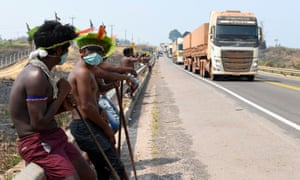
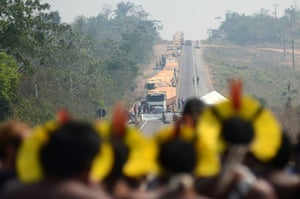
Indigenous protesters on key Brazilian grain highway BR-163 temporarily lifted their roadblock on Tuesday to allow a long line of trucks carrying corn to pass, but said they will stop traffic again in late afternoon.
Members of the Kayapó tribe had blocked the route in center-west Brazil on Monday with tires and wooden planks, protesting against a lack of government protection from the coronavirus pandemic that has killed several of their elders. That jammed up loaded trucks for 3 kilometers.
The highway links towns in the nation’s biggest farm state Mato Grosso to the port of Miritituba, an important export river gateway in Pará state.
With the soy season almost over, the main grain transported on the road at present is corn.
A Kayapo Indigenous man attends a protest at sunrise as they block highway BR-163 near Novo Progresso, Para state. Photograph: André Penner/AP
Highway police in Santarém confirmed that the tribe had lifted their blockade and planned to restore their barriers at 6pm (21.00 GMT) when a court order was due to arrive.
A judge issued a ruling on Monday ordering the demonstrators to unblock the road in the region of Novo Progresso, southern Pará state.
Kayapó men carrying wooden weapons and wearing warrior body paint and headdresses told a Reuters photographer that they would continue their protest because no authority had come to hear their demands.
Kayapo Indigenous people after the reopening of the BR-163 highway, during a protest against the government measures in the indigenous lands to avoid the spread of the coronavirus disease. Photograph: Lucas Landau/Reuters
They were also protesting against the so-called Ferrogrão railway, set to cross part of the Amazon to connect grain-producing Mato Grosso state to river ports for soy and corn.
The railway will run parallel to the BR-163 highway, which has become an important route for exporting grains to the river ports for transshipment onto larger ships on the Amazon river.
The Kayapo, who live on the adjacent Menkragnoti e Baú indigenous reservations, claim the road has brought illness to their villages and are seeking reparation money.
Novo Progresso, Para state. Photograph: Lucas Landau/Reuters
The Canadian province of Quebec on Tuesday announced plans to tackle earlier mistakes in fighting the Covid-19 pandemic, while preparing its health sector against a possible second wave of coronavirus in the autumn.
Quebec, once the country’s hardest-hit province, will boost public health sector hiring, reduce screening delays, and ensure staff like orderlies can no longer work at multiple long-term care facilities, a practice previously blamed for spreading the virus, the health minister Christian Dubé told reporters.
Canada has flattened its curve of coronavirus cases since the spring, but some of the country’s 10 provinces have reported higher numbers of Covid-19 infections recently, as the economy restarts and restrictions on social gathering are relaxed. Schools across Canada will be reopening in autumn.
Quebec accounts for about half the country’s 122,872 total coronavirus cases and more than half of its 9,032 deaths. But the once hard-hit province has only reported 46 new cases and two deaths in the last 24 hours, according to government data.
“We have done an appraisal of this first wave so we can now establish the solution to be implemented in view of a potential second wave,” Dubé said.
There will no longer be movement of workers, other than nurses under certain conditions, between seniors’ homes, where most of the province’s 5,727 Covid-19 deaths took place.
Under the plan, Quebec will also invest C$106m (£61m) in public health to allow for the hiring of 1,000 workers to carry out contact tracing and infection control.
Pizza Express has revealed plans to close almost a fifth of its UK restaurants under a financial restructuring that places 1,100 jobs at risk, Sky News reports.
The casual pizza chain said a rescue deal, which must be agreed by creditors, will see 73 of its 470 restaurants close permanently following the deep disruption to trading caused by the coronavirus lockdown and the resulting high street jobs crisis.
UK & Ireland managing director, Zoe Bowley, said the company hoped to redeploy some of the staff impacted.
The restaurant chain announced it is to shut 73 of its restaurants across the UK with the potential loss of 1,100 jobs in a bid to stay afloat in the wake of the coronavirus shutdown. Photograph: Dominic Lipinski/PA
The tally for confirmed cases of Covid-19 around the world reached 21.95 million on Tuesday, and the global death toll rose to almost 776,000.
Brazil is the country with the second highest number of registered cases and deaths with 3.36 million cases and 108,536 deaths.
It’s followed by India, which has recorded 2.7 million cases, and Mexico which has confirmed 57,023 fatalities.
The Dutch prime minister Mark Rutte tightened recommended measures to rein in the spread of coronavirus, warning that if the country does not control new infections the Netherlands could go “back to square one”.
Rutte gave people urgent advice not to hold parties at home and to limit events like birthday celebrations and other private house gatherings to a maximum of six people. However, the Dutch government did not impose any new mandatory restrictions.
“If were not careful, we will be back to square one inside the foreseeable future,” Rutte warned.
“If people want to organise parties for more than six people, they should rent a space where all guests can maintain social distance while seated,” the prime minister said. He also urged people to continue working from home.
The Dutch PM during a press conference about the current state of affairs in the country regarding coronavirus, in The Hague. Photograph: Bart Maat/EPA
His comments came after the Dutch public health institute announced that there had been just over 4,000 new confirmed cases in the Netherlands over the last week, around the same number as the previous week.
The percentage of positive tests in the country edged very slightly lower to 3.5%. The confirmed Covid-19 death toll in the Netherlands stood at 6,175 as of Tuesday, although the true figure is believed to be higher because many people thought to have died were not tested.
The number of new confirmed cases has been on the rise since the Netherlands removed most of its coronavirus restrictions on 1 July. Students returned to high schools in the country’s north this week for the first time in months without requirements for face masks or social distancing between children.
To prevent infections at schools, Rutte said students must stay home if they have coronavirus symptoms and if somebody in their family tested positive for the virus.
We showed between March and June that we could, together, get on top of the virus. Now we have to show that we can keep the virus under control together.
Ireland significantly tightened its nationwide coronavirus restrictions on Tuesday to rein in an increase in cases, urging everyone to restrict visitors to their homes, avoid public transport and for older people to limit their contacts.
A surge in cases over the last three weeks after Ireland had one of Europe’s lowest infection rates for several weeks, pushed the country’s 14-day cumulative cases per 100,000 population to 26 and led to the first local lockdown last week.
The 190 new cases on Tuesday, the second highest daily rise since early May, took the rate of growth in the last two weeks to the fourth highest in Europe and meant infections would inevitably spread to the most vulnerable if it continued, the prime minister Micheal Martin said.
“We’re absolutely not at a stage where we can return to normality. We are at another critical moment,” the Taoiseach told a news conference, saying the new measures would stay in place until 13 September.
Ireland has adopted one of the most cautious approaches in Europe in fighting the virus, reopening its economy at a slower pace and keeping many restrictions in place for longer.
The government has already twice-delayed the final phase of its reopening plan that would allow nightclubs and all pubs to open, having sped up the plan in June when cases began to fall.
As well as cutting to six the number of visitors allowed in a home – where most clusters have occurred – outdoor gatherings are being restricted to 15 people from 200, with all fans banned from sport. Police will get greater powers to enforce the rules.
Restaurants and pubs that serve food can stay open. Martin said the aim of the restrictions was to make sure key parts of the economy kept trading and schools could reopen for the first time since March.
“Schools are so important to children in general, to society, to the economy as well, that we want our schools to reopen, and our schools will reopen,” Martin said.
Zimbabwe has shortened an overnight curfew imposed to combat the coronavirus pandemic and extended business hours despite rising cases, the government said after a weekly cabinet meeting.
President Emmerson Mnangagwa last month announced a 6pm to 6am curfew, but the information minister Monica Mutsvangwa said this had left commuters stranded without transport.
The overnight curfew will now start at 8pm, while business hours will be extended to 4.30pm from 3pm.
Zimbabwe has recorded 5,308 cases and 135 deaths.
Officials fear a wholesale removal of restrictions on movement would see a surge in infections and overwhelm a health sector that is collapsing due to strikes by workers and lack of medicines and protective clothing.
The government banned public taxis in March, but the state bus service is failing to cope, forcing commuters to queue well beyond curfew hours.
That’s all from me, Caroline Davies . Thank you for your time.