UK coronavirus live: No 10 rejects claim lockdown being eased too soon as England’s schools begin to reopen

Shoppers rushed back to high streets and retail parks on Monday as the reopening of car showrooms, markets and some Ikea stores marked the easing of lockdown restrictions in England.
The number of shoppers out and about soared 36% across all retail destinations compared with last week’s bank holiday Monday, and was up 21% on Monday two weeks ago, according to analysts at Springboard.
“It appears that even though only markets and car showrooms have opened today in addition to essential stores, shoppers are heading back into bricks and mortar destinations,” said Diane Wehrle, Springboard’s insights director.
While the vast majority of non-essential stores, including clothing, shoe and toy stores, will not reopen until 15 June, a range of other retailers selling products classed as essential such as DIY, furniture and bicycles, have gradually been reopening under lockdown.
Ikea is the latest in a wave of furniture stores to open in the last few weeks, including Dunelm, Furniture Village, DFS and ScS.
A council leader has called for stricter travel rules following the weekend’s chaotic beach scenes in Dorset which saw three people seriously injured after jumping off cliffs into the sea.
Councillor Vikki Slade, the leader of Bournemouth, Christchurch and Poole council, has written to local MPs and the chief constable of Dorset Police after widespread scenes of irresponsible behaviour witnessed across the area’s beaches, including at the limestone arch of Durdle Door.
She said she had witnessed first-hand incidents of people failing to adhere to social distancing rules, illegal parking, widespread barbecues and staff facing abuse when going about their work.

Slade said many of the visitors to the beaches were people who had travelled from outside of the county.
We have asked the police for extra support in enforcing social distancing and we have been told that we are policed by consent and that this is not practical, and that the capacity of the police makes it impossible to achieve.
We have even been asked to stop councillors and residents from calling the police when they have concerns about gatherings, groups and breaches.
We saw the most awful scenes in Durdle Door with the arrival of two helicopters to deal with the stupidity of people jumping from the top of cliffs, cheered and clapped by thousands of beachgoers.
We saw the kettling of people to give space to the helicopters and the closely packed paths as people were told to leave.
We have seen crowds on our beaches, in large groups clearly not from the same household, we have had council officers spat at, abused and intimidated as they go about their work, and I am asking you all to go back to ministers in Westminster and ask them to put a travel restriction on England, as they have done in Wales and Scotland.
In those devolved nations you can only travel five miles from home for reasons other than work or risk fines, and I am asking that a similar policy is brought in for England with immediate effect.
After the three men were seriously injured in Saturday’s incident after jumping from the top of the Durdle Door arch, the popular beauty spot and nearby Lulworth Cove were closed.
However on Sunday, scores of people defied attempts to close the beach and so-called tombstoners could even be seen jumping from the 200ft high sea arch.
The Downing Street lobby briefing has now finished. Here are the main points.
- The prime minister’s spokesman suggested that the government is backing away from its plan for all primary school pupils in England to spend at least a month in school before the start of the summer holidays. In its coronavirus recovery plan (pdf) the government said it wanted “all primary school children [in England] to return to school before the summer for a month if feasible”. Asked if that was still the plan, the spokesman said this proposal remained “under review”. The spokesman also said the government accepted that some primary schools were not able to reopen today. He said:
We have only taken this step because we believe it is safe to do so. The medical evidence considered by government scientists has been published.
It’s hugely important that children do have the opportunity to get back into school and to learn but we are doing this in a very cautious and safe way.
We fully understand that there will be some schools who feel that they need more time to prepare.
We are [looking at] what additional measures may be required to ensure every child has the support they need, including over the summer.
- Downing Street urged people not to abandon social distancing rules. Asked about reports that in some places over the sunny weekend people people seemed to have abandoned social distancing, the prime minister’s spokesman said:
Over the course of the pandemic people across the country have made huge sacrifices and we thank them for it. We all need to still play our part. And it’s important that people should continue to follow social distancing guidelines and to stay two metres apart.
We will only continue to keep the virus under control if people continue to follow social distancing rules.

- No 10 rejected calls for the easing of lockdown to be paused. Asked about the statement from the Association of Directors of Public Health (see 9.25am) saying it was too soon the relax the lockdown, the spokesman said the changes being made were “limited and … cautious” and that the government was only implementing them because it had met its five tests. (The ADPH does not accept that the five tests are being met. See 10.02am.) The spokesman also claimed it was “unlikely” that the measures taken to relax the lockdown in England would push R, the reproduction number, back above 1. He said:
We have worked to gradually and safely ease the lockdown measures, the consensus from the scientists is if test and trace is up and running and the public follow the social distancing guidance then it’s unlikely the measures will push the R above one.
- The spokesman defended the government’s decision to start easing the lockdown in England even though the Covid alert level has not fallen. In its recovery plan (pdf) published last month, the government said:
The content and timing of the second stage of adjustments will depend on the most up-to-date assessment of the risk posed by the virus. The five tests set out in the first chapter must justify changes, and they must be warranted by the current alert level.
At the time the government said that the alert level would have to go down from 4, the current level, to 3 before the current restrictions could be eased. Here is a slide it produced at the time.

But the alert level, which is determined by the joint biosecurity centre, is still at 4, even though restrictions are being eased in England. Asked to justify this, the spokesman said that the alert level was “moving down from 4 to 3” and that the five tests had been met.
- The spokesman defended the government’s decision to issue new advice to the 2.5m people in the “shielding” category (extremely clinically vulnerable) at the weekend. (See 1.19pm.) He said it was a “very cautious change”, issued in accordance with medical and scientific advice. But he refused to say the move had been explicitly authorised by Sage, the Scientific Advisory Group for Emergencies. The announcement caught those affected by surprise. One person who did not know it was coming was Dr Nikita Kanani, head of primary care at NHS England.
Dr Nikita Kanani
(@NikkiKF)🚨 I have – understandably – had a number of messages about the #shielding announcements made last night and expected today.
As soon as I know more, I will post on this thread. In the meantime, please continue to follow the guidance set out:
1/2
- The spokesman said the police would be expected to “exercise discretion” when enforcing rules that technically make it illegal for a couple not living together to have sex indoors. See 10.38am. Asked about this apparent consequence of the way the regulations have been drafted, the spokesman also stressed that the police did not have the power to enter people’s homes to investigate alleged breaches of lockdown rules. “They cannot enter your home unless they suspect serious criminal activity is taking place,” the spokesman said.
- The spokesman said the government had not been including figures for the number of individuals tested in its recent daily testing figures because one of the government’s commercial partners doing testing had not provided figures.
- The spokesman said there was no requirement for MPs to vote on the move to impose quarantine on people arriving in the UK. There has been speculation that, if there were a vote, the government might be at risk of losing because so many Tory MPs oppose the plan.
- The spokesman did not deny reports in the Sunday papers saying that Priti Patel, the home secretary, and Alok Sharma, the business secretary, would be included in a beefed-up coronavirus inner cabinet. Currently all key decisions are taken at the No 10 C-19 morning meeting, attended by Boris Johnson, Dominic Raab, Michael Gove, Rishi Sunak and Matt Hancock. The spokesman said that a series of organisational changes were being made and that there would be an announcement in the next couple of days.
- The spokesman said the attacks on journalists covering the rioting in America were “very concerning”.
- The spokesman was unable to say how many people with coronavirus have had their contacts traced through the new test and trace system that went live last week. But he confirmed that the system was not yet operating at full capacity.
- Matt Hancock, the health secretary, is taking the government press conference this afternoon, the spokesman said.
- The cabinet will meet tomorrow, the spokesman said.
Early indications suggest the number of pupils back in the classroom across England today varies significantly depending on local area.
Schools have begun reopening to pupils in reception, year 1 and year 6 in England, and nurseries have also opened their doors to more children.
However, a survey of councils by the PA Media news agency has found dozens of local authorities across England, predominantly in the north, are advising against a return to school on Monday amid safety concerns.
Some have raised concerns the test and trace programme is not yet “robust enough” to sufficiently reduce Covid-19 transmission in schools, where social distancing is hard to maintain with children.
But in some areas of England – such as Kingston and Richmond in London – local authorities report the vast majority of primary schools are providing some provision for priority year groups from Monday.
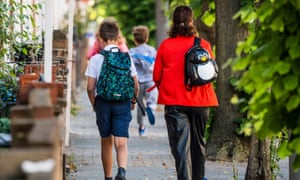
It is not yet clear how many parents opted to send their children back to school but a recent survey suggests heads were expecting around half of families to keep pupils at home.
Cathy Moden, headteacher of Hiltingbury infant school in Chandler’s Ford, Hampshire, said she had anticipated 45 of the 90 children in reception to attend on Monday but only 39 turned up.
Kieron Smith, from Blyth in Northumberland, who has a son in reception, told PA he would not be sending his child back to school until he has more confidence in the government’s approach.
“All in all, it’s not worth it. It’s not a risk I’m able to tolerate. The government have not assured us of our children’s safety.”
The government’s aim is for all primary school pupils to return to school before the summer break.
In a message to heads ahead of the reopening, Paul Whiteman, general secretary of the National Association of Head Teachers, said:
We will be arguing that a full return before the summer break is not possible based on the advice we have from the Department for Education.
Despite the narrative from the government, the level of confidence for a return to schools remains low.
The next few days will reveal whether the government has passed the confidence test. We will discover how many families feel confident to come to school. And we will get a sense of the reaction from staff too.
Telling the most vulnerable they can now go out fits the ‘good news’ narrative. But where is the evidence behind this U-turn?
The announcement came out of the blue. On Sunday, the government said 2.2 million high-risk “shielders” in England and Wales will be allowed to go outside for the first time from Monday if they feel “comfortable”, either with members of their household, or, if they live alone, to meet one other person. These are people who, for the last 10 weeks, have been told to stay in their homes 24/7, without any break for exercise or fresh air.
This marks a remarkable U-turn from ministers. Previous guidance advised that people with serious underlying health conditions, such as lung disease or low immunity, would need to shield until the end of June. And there was no mention of an anticipated change in last week’s announcement easing lockdown for the wider public, nor any advance warning to health professionals. Disability organisations and charities appear to have been taken aback by the move, with the MS Society telling me they were “extremely concerned”.
From the outset of the pandemic, the government’s communication to shielders has been found wanting, to the extent that many didn’t even know how long they were supposed to shield for. The latest update – announced via tweets at 10pm on a Saturday night and trailed in the press – was like moving the goalposts on the quiet. Rather than hearing it first from a government briefing or from their doctor, shielders had to find out about the change on social media.
When I spoke to people affected, the reaction was one of confusion, anxiety, and anger. Some noted that they had been told by their doctors only 24 hours earlier that they would need to shield for at least another month. “There’s no way I’m trusting the government’s advice,” was the general response.
Read the original article at The Guardian